Colt
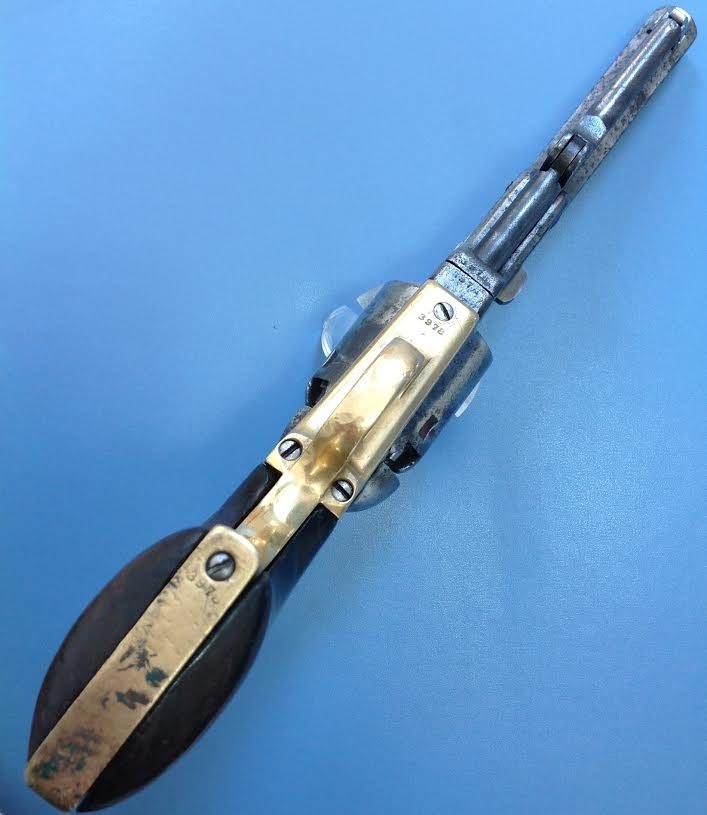
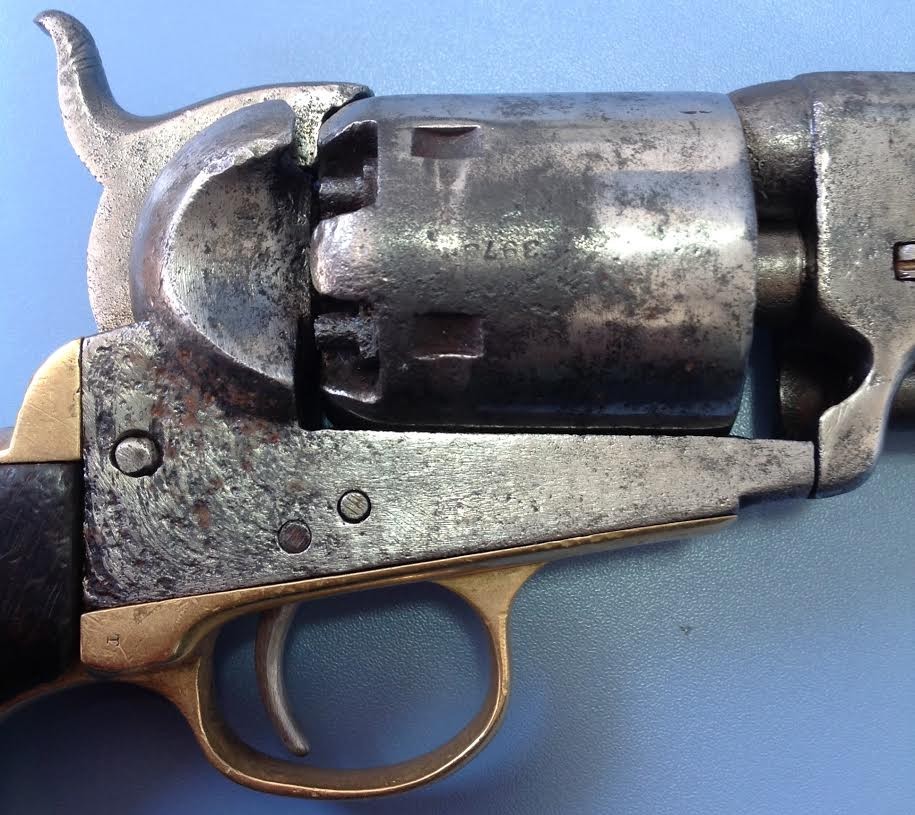
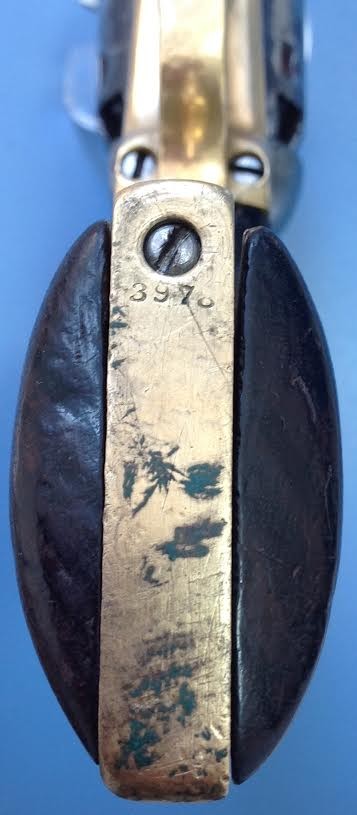
Pocket 1849 PEDRO II
Referring to the following text about Pedro II, it can
only be an original Colt Pocket 1849, perhaps delivered "in white" without a
cylinder scene.
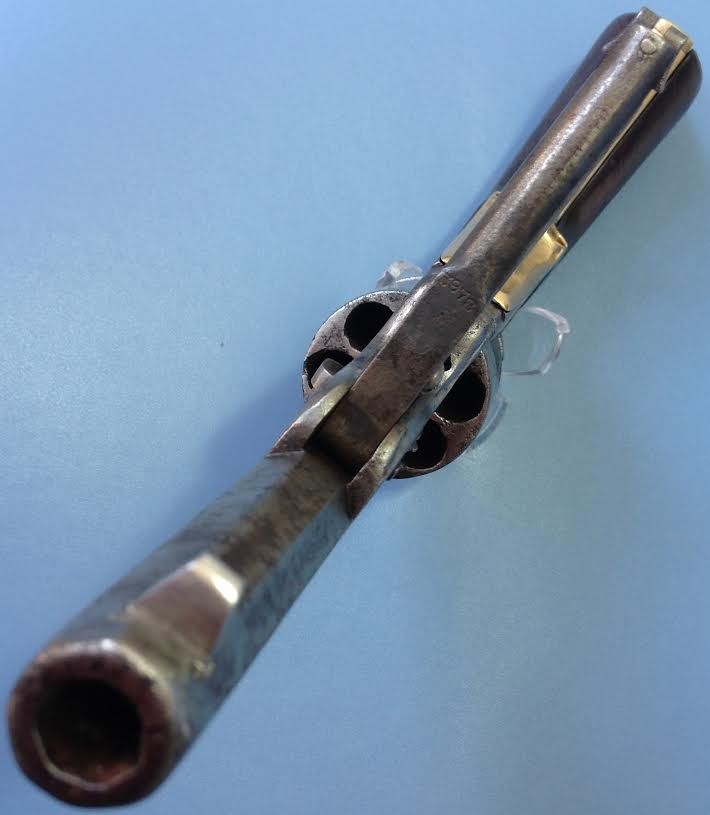
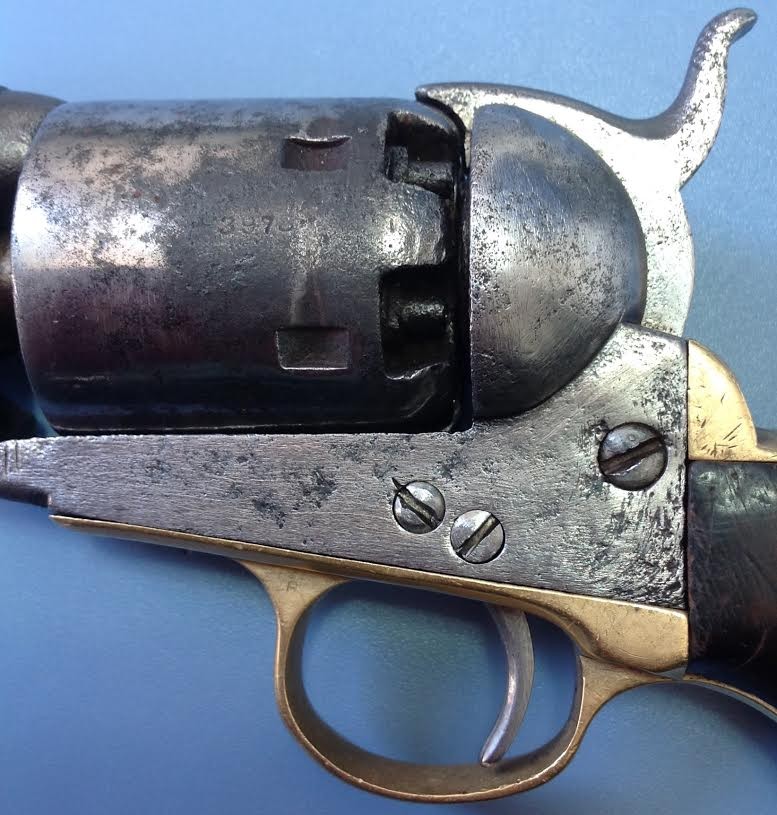
It's details like these that made me hesitate, along with
its lamentable condition and the lack of any visible Colt markings. It can't be
a Baby Dragoon, which has round locking dimples, a squareback trigger guard, and
no built-in loading lever.
There are actually five variations of the Baby Dragoon,
all with a squareback trigger guard:
Model I: No loading lever, round locking dimples, NO
exhaust groove in the shield.
Model II: Same, but WITH an exhaust groove.
Model III: Identical to Model II; I'm not sure of the
difference. The Blue Book says nothing about this, but according to James
Serven—who considers the Baby Dragoon the "prototype" of the Pockets—the
difference lies in the rifling (right-handed and shallow in the II, left-handed
and tighter in the III).
Model IV: Same as III but with square locking dimples.
Model V: Same as IV but with an integrated ramrod.
The Model V is easily confused with the Pocket 1849, from
which it differs only by its squareback trigger guard.
Marcel
HOW THIS COLT GOT HERE... by your friend Mr. Aldo from
Brazil (Please bear with me, this is translated from the Portuguese text
below!!)
I have only seen one example to date, in the reserve
collection of the Paulista Museum. According to our research, the Empire
imported Colt Pocket and Navy pistols around 1851. It is also certain that these
Colts were used by officers during the Battle of Monte Caseros, the date of
which more or less coincides with the launch of the Colt Navy (1851), well after
the Pocket (1849). What I brought up in this discussion: according to our
friend, the historian Adler Fonseca, of the Conde Linhares Museum, "information
is very scarce, coming from documents from the Minister of War to the
Directorate of the War Arsenal." One of them, dated January 27, 1852, requests
the Minister of Finance to release the pistols arriving from the United States
aboard the ship Frederick Dening. Another, dated February 13, 1852, orders the
preparation of bullets and cartridges for the pistols arriving on the Frederick
Dening. The most descriptive document is a notice dated March 4, 1852, the text
of which can be summarized as follows: "Your Excellency is requested to have the
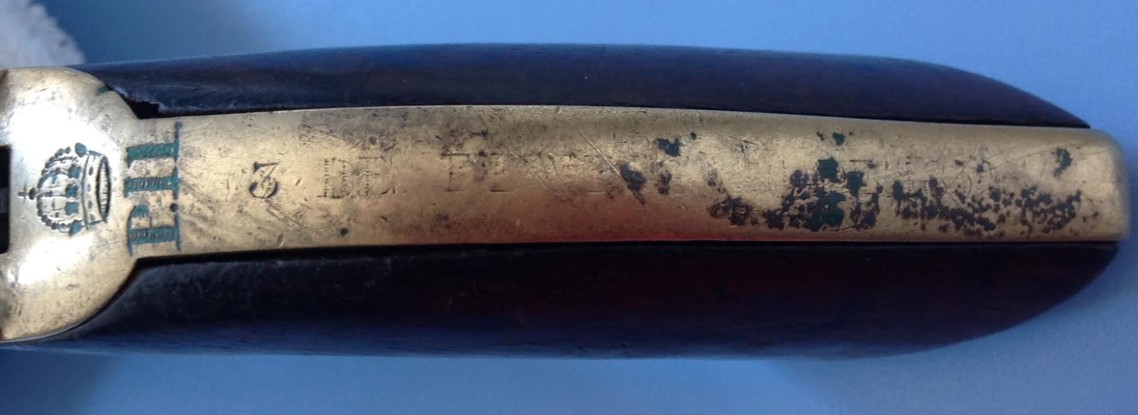
Imperial Crown with the motto PII engraved as a matter of urgency on the
American pistols, followed by the inscription = February 3, 1852. (This is
precisely what is engraved on the remaining barrel of this Colt, below the
Imperial Crown with the monogram PII… personal observation.)"
Finally, a notice dated March 16, 1852, orders the
shipment of twenty-five American pistols to Montevideo, at the disposal of the
Count of Caxias. Note the coincidence of this date with that of your weapon. In
other words, your revolver is precisely part of this batch. Another point to
consider: in 1854, the Imperial Arsenal received a proposal from Frederico &
Southwar & Co., located at No. 69 Rua da Quitanda—if I'm not mistaken, this was
the address of a famous Rio gun shop, whose name I've forgotten—for the sale of
Navy pistols "made by Hitchcock & Co." of New York. This is certainly a mistake.
Moreover, these were not Navy pistols, as there were two models: one weighing
three pounds and 103 octaves (the Portuguese model, not to be confused with the
English models—this weight is excessive; it must be a mistake) and the other one
pound and 69 octaves (too light), which could be the Pocket model. The Arsenal's
opinion was that the heavier pistol was suitable for naval service and the
lighter ones for officers. This was merely the Arsenal's assessment; normally,
an opinion from the Minister would have been issued, either approving or
disapproving the purchase. In this instance, no opinion was issued, so it is
impossible to know what was done. However, another document, from the
Improvement Commission, mentions these pistols, with an unfavorable opinion
regarding their purchase, because the weapons were: "Firstly, Models No. 1 and 2
of revolver pistols are based on Colt's original invention, each with six shots.
Now, this invention is more advanced, requiring only a simple pull of the
trigger to cock and decock the hammer; this is undoubtedly a considerable
advantage. Therefore, if six-shot revolver pistols [as the Commission deems
appropriate] are to be purchased, preference should be given to the most
recently improved models and not those proposed." In summary, there is no doubt
that the Imperial Army, even on a small scale, used Colt, Navy and Pocket
revolvers in its ranks, most likely as sidearms for officers and
non-commissioned officers.
COMO SURGIU ESTE COLT...by your friend Mr Aldo of the Brazil
Só
vi uma dessas até hoje, na reserva técnica do Museu Paulista. Até onde podemos
pisar em terra firme, houve uma importação de Colts Pocket e Navy pelo Império,
por volta de 1851. O que também é garantido é de que esses Colts foram
utilizados por oficiais na Batalha de Monte Caseros, cuja data coincide um pouco
com o lançamento dos Colt Navy (1851), bem mais tarde do que os Pocket (1849). O
que levantei nessa discussão: Segundo nosso amigo historiador Adler Fonseca, do
Museu Conde Linhares, ".....As informações são muito escassas, de documentos do
ministro da guerra para a diretoria do Arsenal de Guerra”.
Um deles, de 27/01/1852. pedindo que o ministro da fazenda libere as pistolas
vindas dos EUA no navio Frederick Dening. Outro de 13/2/1852 mandando preparar
balas e cartuchos para as pistolas vindas no Frederick Dening. O mais
descritivo é um aviso de 4/3/1852 cujo texto se resume a: “Mande V.Sa. com toda
a urgência gravar nas pistolas americanas a Coroa Imperial com o dístico PII., e
em continuação a inscrição = 3 de Fevereiro de 1852.(JUSTAMENTE O QUE ESTÁ
GRAVADO NA CONTINUAÇÃO DA SOLEIRA DESTE COLT, ABAIXO DA COROA IMPERIAL COM O
MONOGRAMA PII...minha observação) ” Finalmente, um aviso de 16/3/1852 diz
para remeter para Montevidéu, à disposição do Conde de Caxias, as vinte e cinco
pistolas americanas. Note a coincidência da data com a da sua arma. Ou seja, seu
revólver é exatamente parte desse lote. Outro aspecto da discussão: Em 1854 o
Arsenal Imperial recebeu uma proposta de Frederico & Southwar & Co. no n.º 69 da
Rua da Quitanda - se não me engano era o endereço da uma loja famosa de armas no
Rio, me esqueci o nome, para venda de pistolas Navy "fabricadas por Hithcock &
Co", de Nova Iorque. Certamente, isso está errado. Também não eram Navies, pois
eram de dois modelos, uma pesando três libras e 103 oitavas (portuguesas, não
confundir com as inglesas - está pesada demais, deve ser um erro) e a outra uma
libra e 69 oitavas (leve demais), o que pode ser o Pocket. O parecer do Arsenal
era que a mais pesada era adequada ao serviço do mar e as mais leves para
oficiais. Isso é apenas a avaliação do Arsenal, normalmente haveria um parecer
do ministro concordando ou discordando com a compra.
Nesse caso, não há, não dá para saber o que foi feito. Entretanto, outro
documento, da Comissão de Melhoramento, fala dessas pistolas, o parecer sendo
contrário à compra, pois as armas eram: "1º que as amostras n.º 1 e 2 de
pistolas Revólveres são as da primitiva invenção de Colts de seis tiros cada
uma, entretanto que atualmente se acha mais aperfeiçoada esta invenção,
empregando-se apenas um só movimento do gatilho para armar e desarmar
seguidamente o cão; o que é, sem contradição, de grande vantagem. Se portanto se
houver de comprar pistolas Revólver [como a Comissão julga conveniente] de seis
tiros, sejam preferidas as ultimamente aperfeiçoadas e não as oferecidas.” Em
resumo, não fica dúvidas de que o Exército Imperial, se bem que em escala não
muito alta, utilizou revólveres Colt, Navy e Pocket, em suas fileiras, muito
provavelmente como arma de porte de oficiais e graduados. ””””