
Francisco Arizmendi
The 6.35
centerfire cartridge emerged at the very beginning of the 20th century, thanks
to the work of the brilliant John Moses Browning. From its introduction around
1906, this pocket gun cartridge quickly became dominant and contributed to the
gradual disappearance of other, now obsolete, calibers (pinshot, black powder
centerfire, and rimfire cartridges of various calibers, with the exception of
the .22, which remains in use today).
The
pocket gun market, particularly active at that time, encouraged numerous
manufacturers of various nationalities to offer semi-automatic revolvers and
pistols chambered for this cartridge.
The small
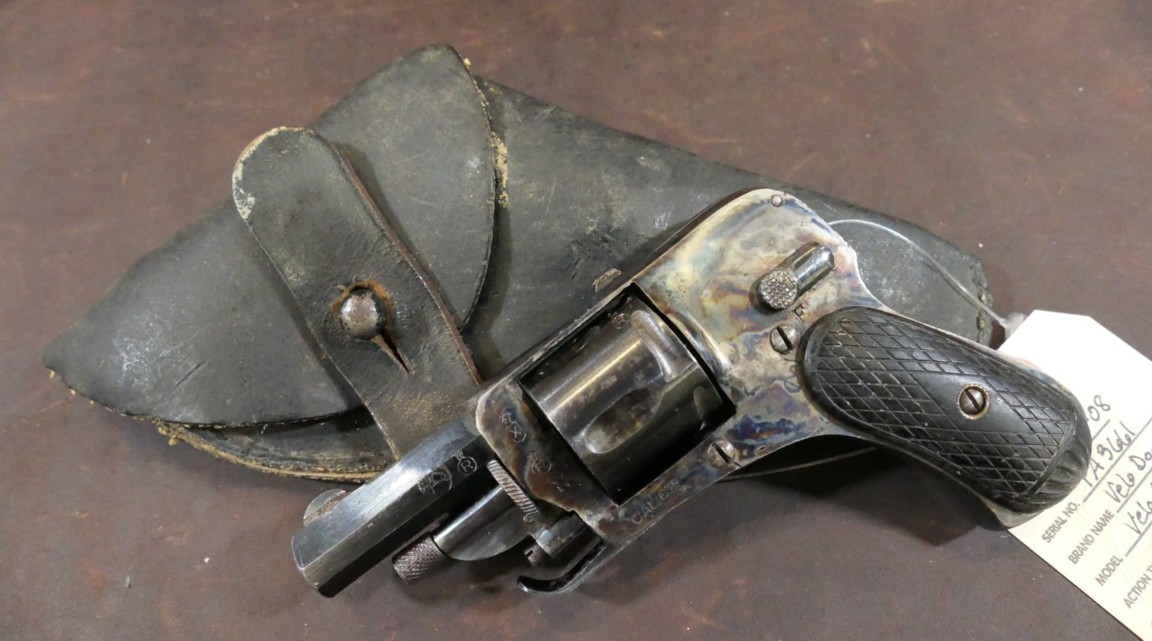
revolver examined here is a good example. It belongs to the family of hammerless
revolvers, often nicknamed "Hunchback" or "Hammerless." This variant of the
British Bulldog design was marketed for two main reasons: firstly, for cosmetic
reasons, giving the weapon a modernized look, closer to that of a semi-automatic
pistol, and secondly, to reduce the risk of the hammer catching on the trigger
when it was quickly drawn from a trouser or jacket pocket! This latter aspect is
complemented by the recessed trigger, resulting in a particularly compact
weapon.
The
example presented here appears to be of very good quality and in excellent
condition, with its bluing preserved, its octagonal barrel, its checkered grips
in fairly good condition, and its safety located at the rear of the frame.
Its
Spanish origin is evident from the proof marks:
The coat
of arms of Eibar, two crossed bars surmounted by a plumed helmet. This has been
the symbol of the BOPE (Banco oficial de Pruebas de Eibar) since July 9, 1931.
The
letter R within the grenade. This is the BOPE proof mark for revolvers.
The
capital N could correspond to the year number for Spanish firearms, in this case
1942, which seems rather late for this type of product. Perhaps the N stands for
Nitro?
Two other
markings are identifiable and allow us to put forward a very credible hypothesis
about the revolver's manufacturer:
On the
grip butt, the marking FA 3661. The number probably indicates the weapon's
serial number. The initials FA correspond to those of the well-known
manufacturer Francisco Arizmendi of Eibar. Several revolvers similar to this
one, clearly bearing the manufacturer's mark, can be found on the site; see:
https://www.littlegun.info/arme%20espagnole/ancien%20artisan/a%20arizmendi%20francisco%20gb.htm
An
identical marking can be seen on another Arizmendi revolver (with a different
serial number, of course):
A logo
depicting a policeman brandishing his pistol. This is the logo of the German
arms importer AKAH (Albrecht Kind), with whom Arizmendi worked, as demonstrated
on the site (see link above). Founded in 1853, the company is still in
operation. Some historical information can be found online, but it remains
rather vague about the period from 1940 to 1945…
It should
be noted, however, that the photos provided do not show the logo usually used by
Arizmendi, namely a star above a crescent moon, surmounted by the initials FA.
In
short, this 6.35 caliber "hunchback" type revolver was produced in Eibar between
1931 and 1942. Its manufacturer was almost certainly Francisco Arizmendi. The
weapon was intended for import into Germany by the AKAH (Albrecht Kind) company.
Chris


Francisco Arizmendi
This
weapon is a revolver of type Velodog, hammerless, in calibre 6,35 mm, in
(ochavado) octagonal barrel - fabricated in Eibar (Spain).
It' s a
revolver classic of its kind, with folding trigger, with variant of end bent
back, instead of a kind of small striated bowl. Variations on style are so
abundant as no collection would include them all.
The
producer is Francisco Arizmendi, perfectly identifiable by his logo, on the
right hand side, above safety.
Roberto


